
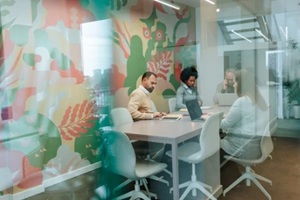
 Digital wallpaper lets designers make a single floor plan feel like several distinct rooms without building a new partition, one of the most useful moves in hybrid office interior design. The same square footage now has to support heads-down focus in the morning and open collaboration by afternoon, and large-format wall coverings are one of the fastest ways to mark those functional shifts.
Used well, custom digital wallpaper in an office earns its place in acoustics, wayfinding, and branding before you even get to how it looks.
Key Takeaways
|
How Digital Wallpaper Zones a Hybrid Office
Most hybrid offices are not short on square footage. The trouble specifiers keep hitting is legibility, since a floor where every surface looks alike gives people no cue about where to buckle down and where it is fine to talk. Digital wall coverings answer that by giving each area its own visual identity, so a change in pattern density or color depth marks the shift from a focus zone to a collaboration hub. The best office wallpaper ideas start from how the room is actually used, not from a swatch book.
Wallpaper handles the visual boundary, but it does nothing for how a room sounds, which is where a shared hybrid floor gets tiring. Backing a collaboration zone with acoustic art panels reduces the reverberation that wears people down in open areas, and the printed face can repeat the same image as the surrounding mural. Where a firmer barrier is needed, acrylic dividers hold a frosted or graphic insert that separates a huddle spot without cutting it off from daylight.
Zoning by sight pays off because pattern and color change how a room feels and how well people concentrate. Neutral undertones and moderate textures suit focused work, while bolder designs for professional interiors add energy to collaboration areas. A low-contrast mural behind a bank of quiet desks tells people something different than a saturated graphic wrapping a lounge, and workers read that difference without a posted sign.
Designing a Video Conferencing Background Wall
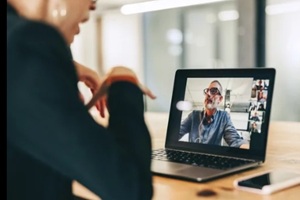 A video conferencing background is a production surface before it is a design surface, and the finish shows up on every call. High-gloss wall coverings bounce ceiling light straight into the lens, which washes out the image behind a seated presenter, so a matte or lightly textured substrate almost always reads cleaner on screen. DreamScape products give that low-sheen result while still holding saturated color and sharp edges in the print.
Pattern scale is the second decision, because a busy, high-frequency graphic competes with the person on camera and breaks into visual noise once a webcam compresses the feed, while a larger, calmer motif survives that compression. Placing the densest part of the design off to one side keeps a logo in frame without crowding the speaker, which is one of the few office wall covering ideas that survive daily use on camera.
Carrying Brand Identity Across a Hybrid Office Design
A hybrid workspace design splits a brand across two environments, the physical floor and the home-based video window, and digital wallpaper is one of the few surfaces that can appear in both. Branded graphics printed for a collaboration zone can be adapted into backdrop panels or matching virtual backgrounds, so a client sees the same visual identity in the office and on a call from a spare bedroom. That continuity is where digital wallpaper branding proves its value across a distributed team.
With a digital wall covering office design, the source files matter as much as the concept. A logo or stock image that looks fine on a monitor can fall apart once it is printed at 54 inches wide, so licensing rights and resolution both have to be checked before production. That review belongs in the design process, which prevents a costly reprint after the material is already installed.
In a commercial space, digital wallpaper must also meet the building’s fire-rating requirements, and Class A fire-rated wall covering options are available for corridors and shared common areas. Codes vary by state, county, and occupancy type, so confirm the specification your project needs with your local authority having jurisdiction or with Tree Towns before the order is placed.
 Speed is the other constraint on a hybrid rollout, and running design, printing, and installation under one roof is what compresses the timeline. A full-wall program that a larger shop might quote at two to three months usually turns around in two to three weeks.
When the schedule is tied to a lease date or a rebrand, that gap decides whether the space is finished by the time employees return.
Choose Custom, High-Impact Digital Wallpaper for Your Hybrid Workspace.
Digital wallpaper gives a hybrid workspace design the ability to zone, brand, and support video calls with one coordinated surface. To match materials and finishes to your floor plan and timeline, contact Tree Towns or request a custom quote for your next project.