
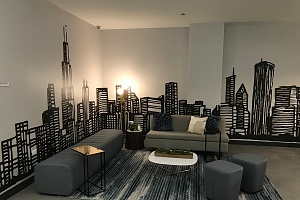
 Choosing a digital wall covering starts with how the wall is used, then whether the print and installation can deliver on it. A product that looks right on a sample board can peel at the seams in a scrubbed corridor or shift color on a textured substrate, so material weight, durability rating, ink system, and wall prep drive the decision more than the design does. Interior designers, facility managers, and project managers comparing commercial wall covering options should weigh custom wall coverings against those factors before approving a proof.
Key Takeaways
|
Match the Material to the Way a Space Gets Used
A surface wiped down with disinfectants every night needs a coated commercial wall covering built to take it, while a lighter decorative stock starts peeling at the edges where moisture gets in. Sorting out how a wall will be maintained and how much contact it takes keeps the custom wall covering selection matched to the space.
The same use-based logic extends to adjacent surfaces, because glass partitions and sidelights call for decorative films. The focus remains on how much use it will take and what performance it demands.
Know What the Durability Ratings Measure
Wall covering durability ratings come from a formal classification called the ASTM F793 standard, which grades each product on washability, scrubbability, abrasion, tear strength, and coating adhesion. To earn a rating, a product must pass every test in its category, so comparing commercial wallpaper types by classification is more reliable than judging them by appearance. A broader overview of commercial wallpaper types is useful background before a spec meeting.
Commercial serviceability breaks into three grades, each demanding higher resistance for heavier use.
- Type I suits offices and other light-duty walls where cleaning is occasional.
- Type II holds up in corridors, lobbies, and other high-traffic areas that take daily contact.
- Type III handles the roughest service, such as loading zones and institutional hallways.
The difference between Type I and Type II wall coverings mainly comes down to scrub and abrasion resistance, so match the grade to the room instead of defaulting to the heaviest one.
Check Print Method and Substrate Before Approving a Proof
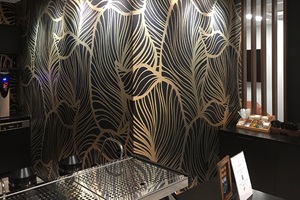
Digital wall coverings are printed on vinyl or non-woven media using latex, UV-cured, or eco-solvent inkjet systems, and each one cures and sits on the surface differently. UV-cured ink lays a hard film on top of the substrate and holds sharp edges well, while latex and eco-solvent inks penetrate slightly and can read softer on textured media.
A textured finish, such as linen, suede, or sand-grain, scatters ink differently than smooth vinyl, so color saturation and fine detail change between substrates even when the print file is identical. Ask for a strike-off printed on the specified substrate and review it at full size under the space’s lighting, since the same ink can look more saturated under LED than it does in daylight.
Account for Acoustics, Fire Rating, and Code
A wall covering is a functional surface with acoustic and life-safety implications alongside its visual role. Textured and fabric-faced products absorb sound, reducing reverberation and echo inside a room but not blocking noise between separate spaces. When reverberation in a conference room or open office is the real problem, acoustic art panels are engineered for that job and pair well with printed walls elsewhere in the plan.
Class A fire-rated options are available, which is the top surface-burning classification for interior wall finishes under the ASTM E84 test, and many commercial occupancies require it for corridors and egress paths. Because adoption varies by state, county, and occupancy type, the specified rating should be confirmed with the local authority having jurisdiction before it is locked into a submittal.
Plan for Installation and Substrate Prep
Digital wall covering installation succeeds or fails on wall condition and seam strategy, which is why the material decision and the install plan belong together. The substrate has to be clean and properly primed, because any existing texture or patched drywall telegraphs straight through a finished vinyl surface. Large-format and pattern-matched graphics need a professional installer, since one misaligned seam means reprinting and rehanging the whole run.
Coordinating substrate prep and panel layout under one professional installation plan removes the guesswork that causes callbacks. Licensing rights and image resolution get reviewed as part of the design process as well, so third-party or brand assets are cleared and print-ready before production begins.
Get Custom Wall Coverings Built for Your Space
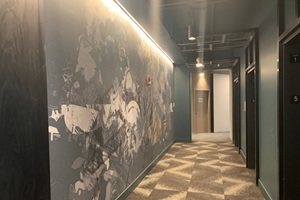 Choosing the right digital wall covering for a commercial project comes down to how the space is used and whether the material and installation can meet it. Tree Towns builds custom wall coverings for offices, healthcare, hospitality, and public works environments, with one team handling design, fabrication, and installation, and a typical turnaround of two to three weeks.
Contact Tree Towns to talk through your space and get started on custom wall coverings engineered for your project.