
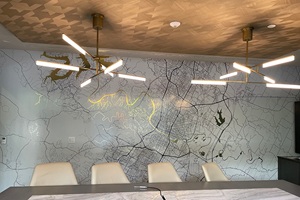
 Digital wall coverings can give a dated lobby or conference room a new look without requiring any structural change. Architects, interior designers, and facility managers in the Chicago area do most of their planning before anything is printed. These pre-install tasks include choosing the right substrate, preparing the surfaces, and booking install dates around people still at their desks.
Printing to Field Measurements Instead of a Pattern Repeat
Conventional wallpaper comes off the roll at a set width, with a pattern that repeats every so many inches. On the other hand, a large-format printing job starts with on-site elevation measurements. From those dimensions, the designer can wrap an image around a column or stop it right at a door casing with exact precision.
Installers on a traditional hang lose time at outside corners, soffits, outlet cutouts, and walls that aren’t quite plumb. With a digital mural, the designer deals with those spots in the file before printing. Panels arrive numbered, with a map indicating where each item goes.
Matching Brand Color on Textured Media
Brand guidelines typically list color as Pantone values proofed on smooth, coated paper. On canvas, suede, or a stipple texture, a solid area in that same value looks a little flatter because the raised surface scatters light. A physical strike-off on the actual substrate goes out for sign-off before the full run. In most cases, approving a sample sheet costs far less than reprinting panels.
Image Resolution and Licensing at Full Scale
At finished size, an image needs about 100 to 150 dots per inch (dpi), according to published file prep guidelines. If the original is a 4-by-6 photo printed 3 feet wide, plan on scanning it at roughly 900 dpi.
Under Shutterstock’s standard license, murals and wall art used as decor in a commercial setting aren’t covered. Buyers who want a stock image for their lobby must pay for the company’s enhanced tier. Logos, brand photography, and anything else the client supplies get the same rights check before layout starts.
Choosing Commercial Wall Graphics Rated for Occupied Spaces
High-traffic areas, including elevator lobbies, staff lounges, and corridors where carts and chair backs scrape the walls every day, need medium-to-heavy grade wall coverings (classified as Type II in ASTM F793).
DreamScape Canvas, DreamScape Suede, and Terralon Regatta all qualify as Type II, according to the published specifications for these custom wall graphics. Each is also listed as Class A fire-rated and meets National Fire Protection Association (NFPA) smoke-development criteria. Finish rules vary by occupancy type and municipality. Confirm them with the project’s Authority Having Jurisdiction (AHJ) during design review.
Canvas is a good fit for photography and painterly work because soft gradients pick up some depth from the woven texture. On that same weave, fine lettering and thin lines start to look fuzzy. Designers usually move text-heavy branded office graphics to suede-embossed or smooth media.
Preparing the Wall Surface Before Installation
If edges start lifting or seams telegraph through after an install, installers first check the wall underneath. Older office drywall usually has mixed sheens, touch-up paint, and bare joint compound from past repairs. Prep crews sand those spots down and prime them with a compatible product.
DreamScape needs a Level 4 or Level 5 drywall finish behind its self-adhesive wraps, primed and then painted twice, according to its installation guidelines. Semi-gloss is preferred because the backing grips a glossier sheen better. Fresh paint should sit for at least three days before anything goes on it, or longer if the paint manufacturer calls for a longer cure.
These wraps won’t work over orange peel or knockdown texture. On those walls, you can skim-coat smooth or switch to a paste-applied, fabric-backed wall covering.
Scheduling Installation Around Daily Operations
Because there’s no demolition, framing, taping, or repainting, a room is out of commission only while installers are in it. With the artwork in panels, the crew can work zone by zone and often finish a lobby wall before the front doors open.
For paste-applied vinyl, DreamScape’s vinyl hanging guidelines require the space to stay above 65 degrees Fahrenheit for 48 hours before installation. If the building engineer sets back the heating, ventilation, and air conditioning (HVAC) at night and over weekends, that setback has to be overridden two days ahead.
On tenant improvement projects, approvals and production take up far more calendar time than the install does. A coordinator with a fixed move-in date can protect it by approving substrate, color, and the strike-off early.
Removable Substrates for Lease Cycles and Rebrands

DreamScape rates Classic and its other repositionable, self-adhesive products for short- and mid-term use. On a wall prepped to spec, installers can peel the material off in full panels, leaving the drywall intact. The adhesive keeps its standard release level for about two years before the bond may start to strengthen. Anything expected to stay up past that point belongs on a paste-applied product.
When a company rebrands, designers should plan the digital murals as one package with the wayfinding, dimensional signage, and other commercial interior graphics in the space. Fresh artwork next to old signs looks half-finished.
Executive suites, boardrooms, and other long-term workplace wall design usually get paste-applied, fabric-backed material. Because it’s dimensionally stable, seams that line up on day one are still lined up years later.
Start Your Wall Covering Refresh With Tree Towns
Tree Towns Digital Decor prints and installs office wall coverings from its Elmhurst shop for commercial clients across Chicagoland. Its staff has been with the company an average of 18 years. Tree Towns usually needs two to three weeks for highly customized work, and one account manager stays with each project from first review to final panel. Call 630-931-2229, contact our team, or request a custom quote with your dimensions and brand files.